
The Hook
Choosing among 3D printing services China offers is difficult because the market includes very different types of providers: exhibition platforms, online manufacturing networks, specialist factories, and rapid-prototyping suppliers. Material availability, production technology, finishing, order volume, delivery coverage, and technical support can vary substantially. A provider suited to a functional nylon part may not be suitable for a presentation model or a manufacturing-industry event. For this comparison, the listed options were assessed against their official websites and available company information, with emphasis on clearly documented capabilities rather than unsupported claims. The result is a practical 2026 watchlist, led by TCT Asia for its relevance to the additive-manufacturing ecosystem.
Full List of Top 7 Brands
- TCT Asia
- JLC3DP
- Made In China
- Huanya3D
- Additive Manufacturing Users Group
- Unionfab
- 深圳3D打印展览会_深圳国际3D打印、增材制造及精密成型展览会_FormnextAsiaShenzhen
Comparison Table
| Brand | Key Products | Key Features | Best For |
|---|---|---|---|
| TCT Asia | Additive-manufacturing exhibition and industry platform | Industry networking, technology visibility, conference and exhibition participation | Discovering suppliers, technologies, and manufacturing trends |
| JLC3DP | Custom 3D-printed plastic, resin, nylon, metal, and full-color parts | Online upload, instant quoting, scalable production, worldwide delivery | Prototypes, functional parts, and low-volume production |
| Made In China | SLA printers, SLA materials, rapid prototyping, and custom services | OEM-oriented SLA production, resin development, rapid prototyping | Customized plastic prototypes and industrial applications |
| Huanya3D | FDM, SLA, MJF, and metal 3D printing services | Nylon options, complex geometries, functional parts, online ordering | Functional components, tooling, architectural models, and prototypes |
| Additive Manufacturing Users Group | AMUG Conference, technical sessions, workshops, and showcase activities | Peer learning, hands-on education, technical presentations, scholarships | Additive-manufacturing professionals and users seeking knowledge exchange |
| Unionfab | Custom on-demand manufacturing, 3D printing, and CNC | Custom manufacturing model combining additive and subtractive services | Businesses seeking consolidated prototype and production sourcing |
| 深圳3D打印展览会_深圳国际3D打印、增材制造及精密成型展览会_FormnextAsiaShenzhen | 3D-printing, additive-manufacturing, and precision-forming exhibition | Industry exhibition and technology-discovery focus | Visitors and exhibitors researching the China AM market |
Detailed Reviews
1. TCT Asia
TCT Asia is positioned as an additive-manufacturing and 3D-printing industry platform rather than a conventional online print bureau. Its official website is dedicated to the TCT Asia brand and its role in connecting the technology, equipment, materials, software, and application communities. That distinction matters: organizations researching 3D printing services China can use the event as a discovery point for suppliers and production technologies, but the event itself should not automatically be treated as a direct contract manufacturer.

The platform is relevant to companies comparing service providers because exhibitions can bring together technology developers, material suppliers, equipment manufacturers, service bureaus, and end users. This gives procurement teams an opportunity to compare processes and application areas in one setting. Depending on the event program and exhibitor roster, visitors may also evaluate developments in industrial additive manufacturing, rapid prototyping, digital production, and related precision-forming technologies.
TCT Asia is especially useful at the early research stage. A product team can use an industry event to clarify whether a project is better suited to polymer printing, metal additive manufacturing, CNC machining, tooling, or another production route. It can also help teams identify suppliers that support prototypes, low-volume manufacturing, production components, materials development, or post-processing. Any final decision should still be based on direct supplier quotations, technical specifications, sample parts, quality documentation, and delivery commitments.
Its value is therefore ecosystem-wide rather than limited to a single material or machine. Visitors can compare technical approaches, meet potential manufacturing partners, and follow market developments through exhibition and conference content. Exhibitors can use the platform to present capabilities to industrial buyers and other participants in the additive-manufacturing supply chain.
Pros / Key Features
- Strong relevance to additive manufacturing and industrial 3D printing.
- Useful for discovering multiple suppliers and technologies in one environment.
- Supports market education, networking, and technology comparison.
- More suitable for supplier research and industry engagement than for direct online ordering.
Use Cases / Best For
TCT Asia is best for engineering teams, procurement professionals, investors, manufacturers, and technology users evaluating the Chinese additive-manufacturing ecosystem. It is also appropriate for organizations seeking potential suppliers before requesting samples or production quotations. Buyers needing a finished part immediately should use a manufacturing service directly rather than treating an exhibition organizer or industry platform as the production vendor.
2. JLC3DP
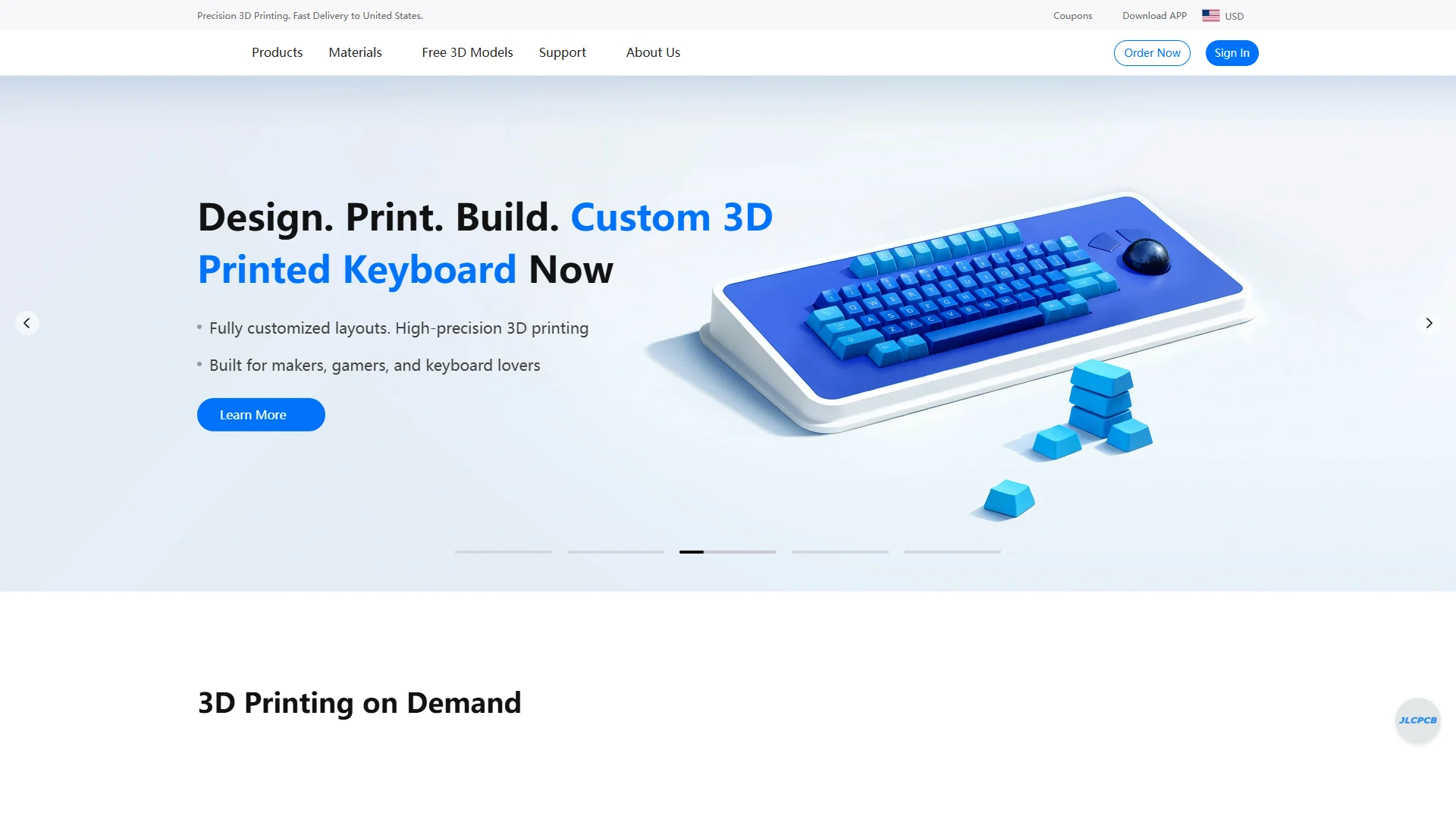
JLC3DP provides online custom 3D-printing services. Its documented workflow allows customers to upload 3D files, select materials, and obtain an instant quote. The company states that it serves customers worldwide and delivers parts directly from its 3D-printing factory.
Pros / Key Features
- Online file upload and instant quoting.
- Materials and processes covering metal, nylon, resin, plastic, and full-color printing.
- Services described for prototypes, end-use parts, complex geometries, and low-volume production.
- Scalability stated from one part to 100,000 parts.
- PCB and 3D-printing orders can be combined into one parcel according to the company’s website.
Use Cases / Best For
JLC3DP is suited to engineers and product teams needing an online ordering process for prototypes, functional components, or small production runs. Its published applications include automotive, aerospace, appliances, and consumer electronics. Buyers should review the selected finish carefully: the company states that support removal is applied by default, while sanding is not included unless separately specified.
3. Made In China
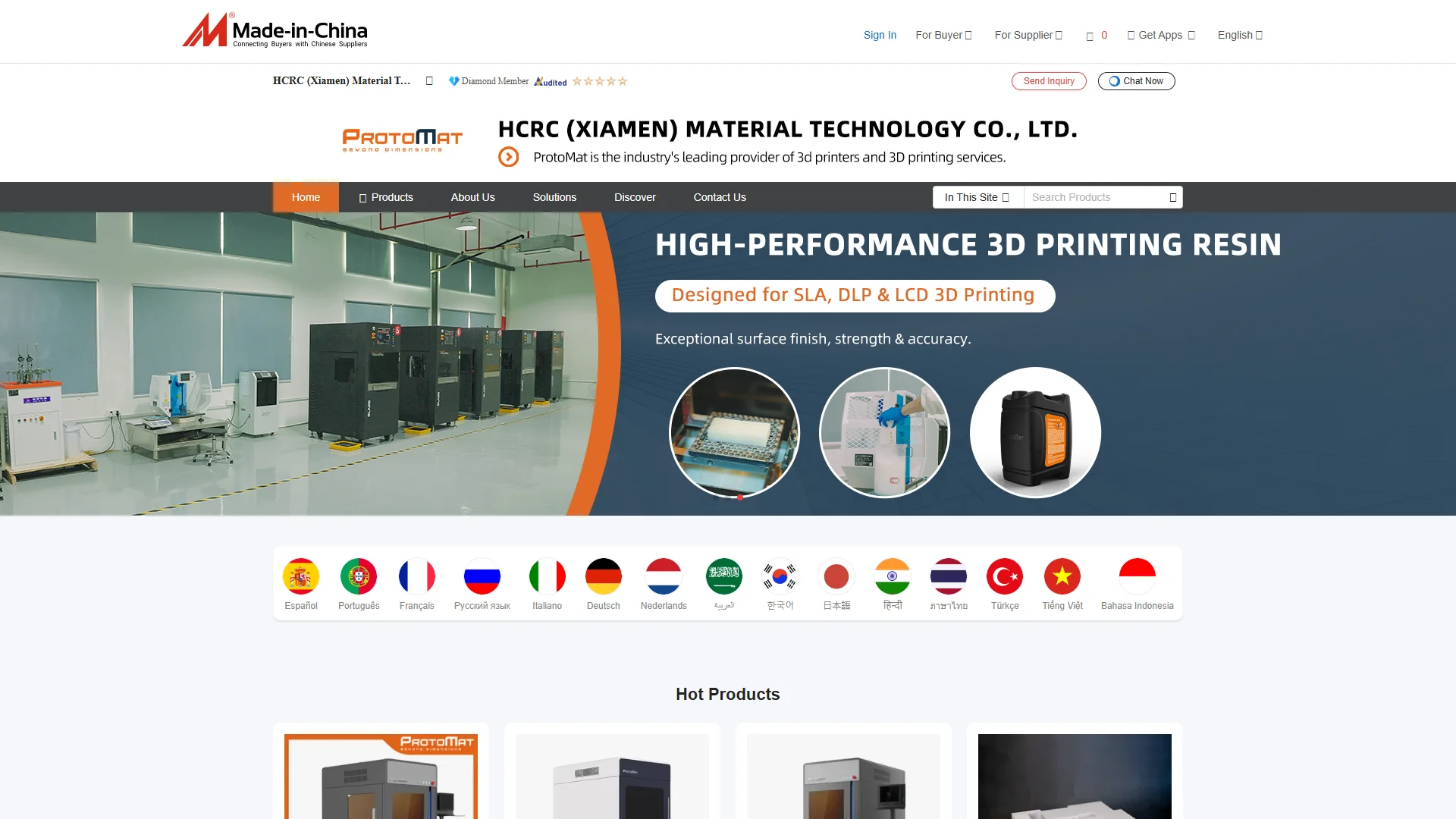
On the supplied company page, Made In China presents HCRC (Xiamen) Material Technology Co., Ltd. and ProtoMat-related offerings as a supplier of SLA 3D printers, SLA materials, rapid prototyping, and custom manufacturing services. The available information emphasizes customized plastic prototypes, OEM-oriented services, and industrial applications.
Pros / Key Features
- SLA 3D-printing services for customized plastic prototypes.
- Development and supply of SLA printing materials and resin options.
- Rapid prototyping and low-volume manufacturing.
- Applications identified across aerospace, automotive, healthcare, and consumer electronics.
- Supplier information includes a Xiamen, China factory address.
Use Cases / Best For
Made In China is a potential fit for buyers seeking SLA-based prototypes, resin development, and customized industrial parts. Its documented sector coverage makes it relevant to product-development teams that need visual or functional plastic prototypes. Buyers should confirm current machine specifications, tolerances, finishing options, certifications, and production capacity directly before placing an order.
4. Huanya3D
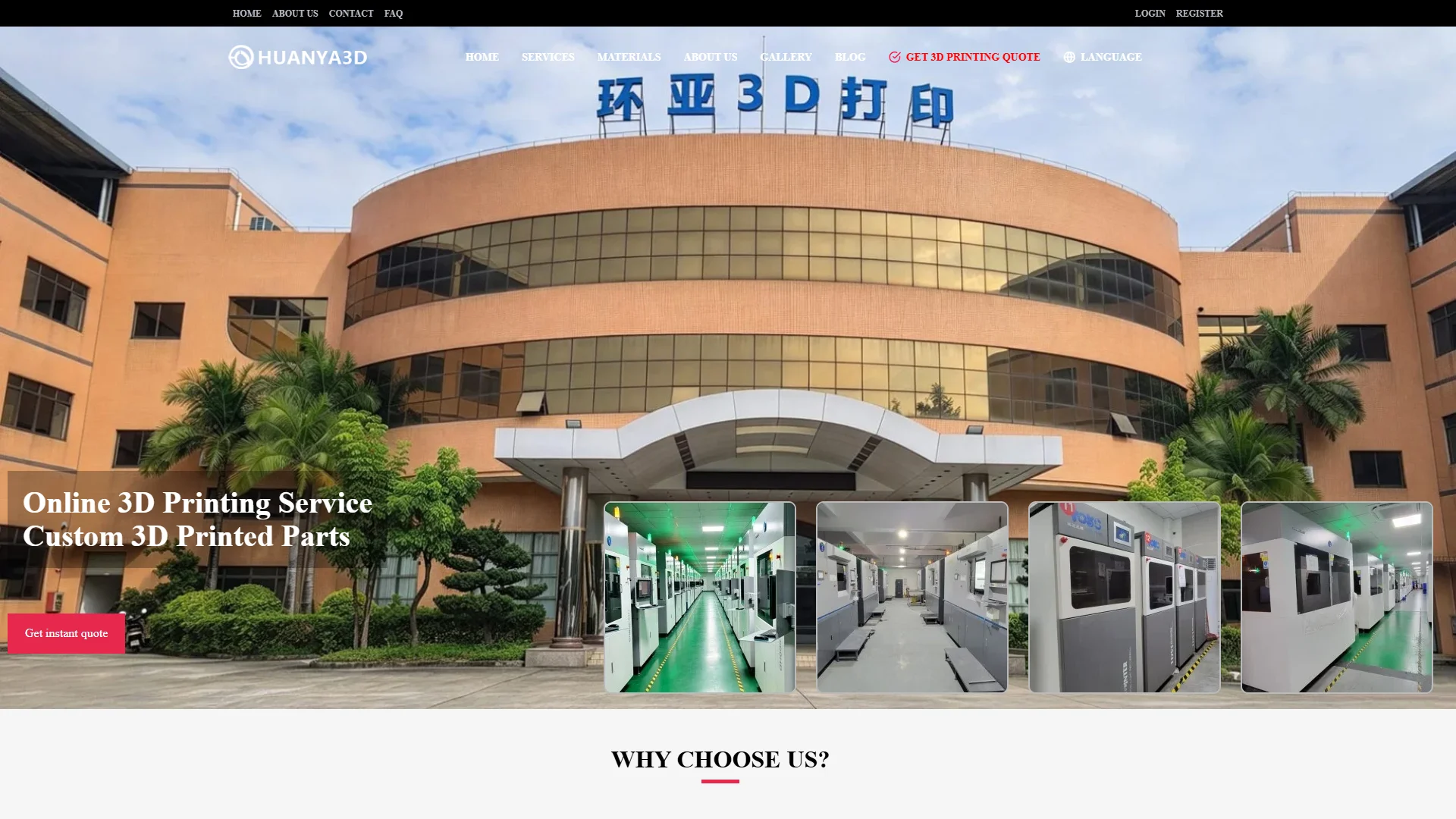
Huanya3D describes itself as an industrial 3D-printing supplier and factory. Its available service information covers FDM, SLA, MJF, and metal-printing applications, with an emphasis on accurate, durable, and customized parts. The published use cases span prototypes, tooling, architectural models, lighting components, electronics housings, robotics parts, and low-volume production.
Pros / Key Features
- MJF and powder-bed production for complex geometries without sacrificial support structures.
- Nylon and reinforced nylon options, including PA12, PA11, TPU, and carbon-fiber-related materials listed on the site.
- SLA resin options such as rigid, flexible, transparent, heat-resistant, and castable materials.
- Functional parts, jigs, fixtures, prototype molds, and tool inserts.
- Online ordering and a stated 2–5 business-day production timeframe for certain online services.
Use Cases / Best For
Huanya3D is best considered for businesses that need more than appearance models, including functional nylon parts, fixtures, small-batch components, and complex assemblies. It also lists applications in architectural visualization, lighting, medical prototypes, consumer electronics, automotive components, and robotics. Since lead times and material availability can depend on part geometry and quantity, project-specific confirmation remains important.
5. Additive Manufacturing Users Group
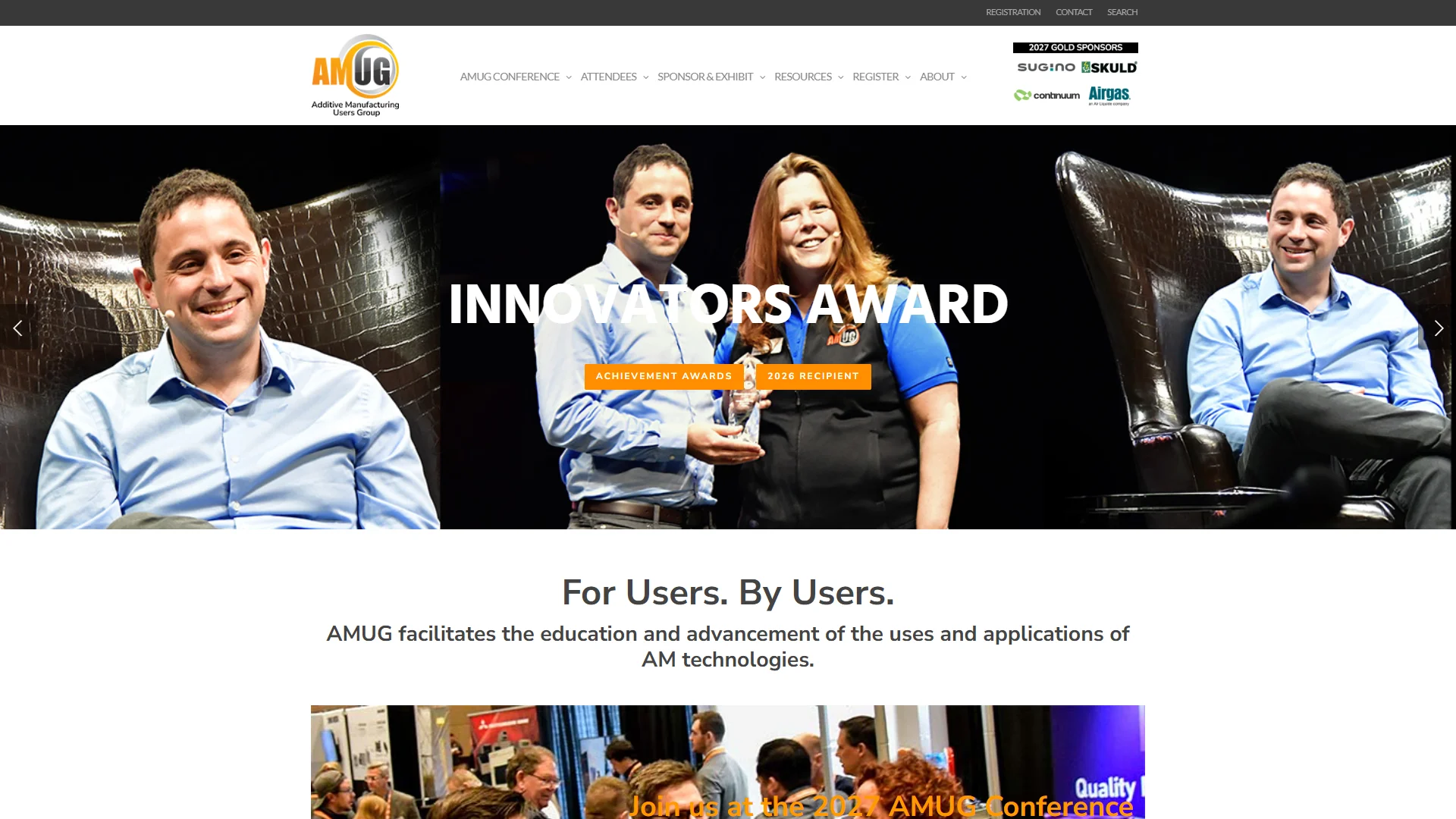
Additive Manufacturing Users Group, commonly associated with AMUG, is an industry user organization and conference platform rather than a conventional 3D-printing service bureau. Its website promotes the AMUG Conference, technical sessions, hands-on workshops, keynote presentations, and the Innovators Showcase.
Pros / Key Features
- More than 100 technical sessions are promoted for the conference.
- Hands-on and interactive workshops.
- Technical knowledge exchange among additive-manufacturing users.
- Innovators Showcase activities.
- Scholarships identified for one student and one educator.
Use Cases / Best For
AMUG is best for engineers, operators, designers, researchers, and managers who want peer learning and practical additive-manufacturing education. It may help procurement teams understand process limitations and production practices, but it should not be selected as a direct vendor for printing parts unless a separate supplier relationship is established through the organization’s network.
6. Unionfab
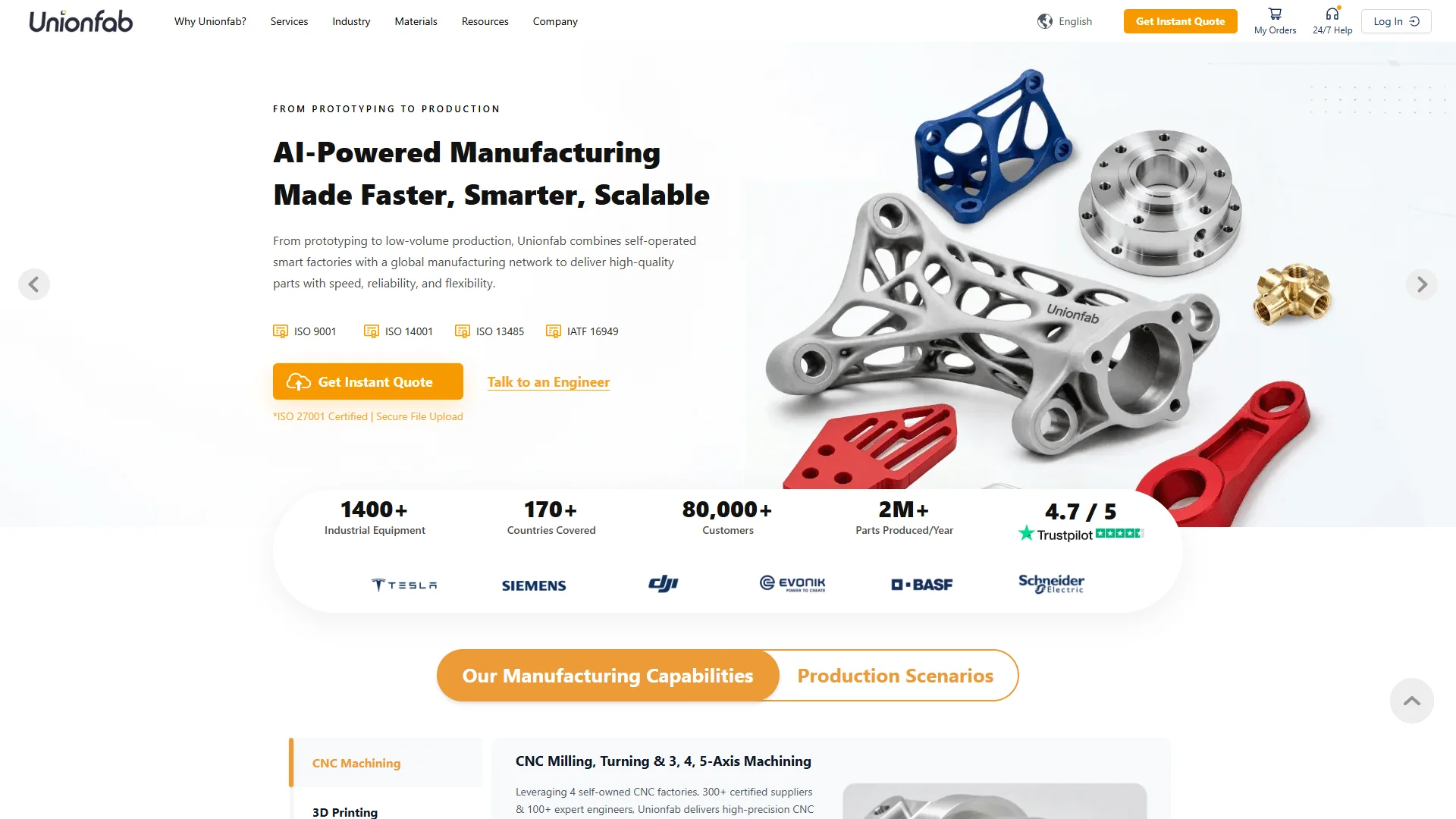
Unionfab’s official website presents the company around custom on-demand manufacturing, 3D printing, and CNC. The available company information does not document a specific founding date, location, material catalog, or detailed production specification, so those points should be verified directly with the provider.
Pros / Key Features
- Combines 3D printing and CNC within a custom-manufacturing offering.
- On-demand production positioning.
- Potentially useful when a project includes both additive and subtractive parts.
- Suitable for businesses seeking a consolidated manufacturing contact.
Use Cases / Best For
Unionfab is best for organizations comparing outsourced manufacturing routes and considering whether different components should be printed or machined. Before ordering, buyers should request process-specific information covering materials, tolerances, finishing, inspection, minimum quantities, shipping, and quality documentation.
7. 深圳3D打印展览会_深圳国际3D打印、增材制造及精密成型展览会_FormnextAsiaShenzhen
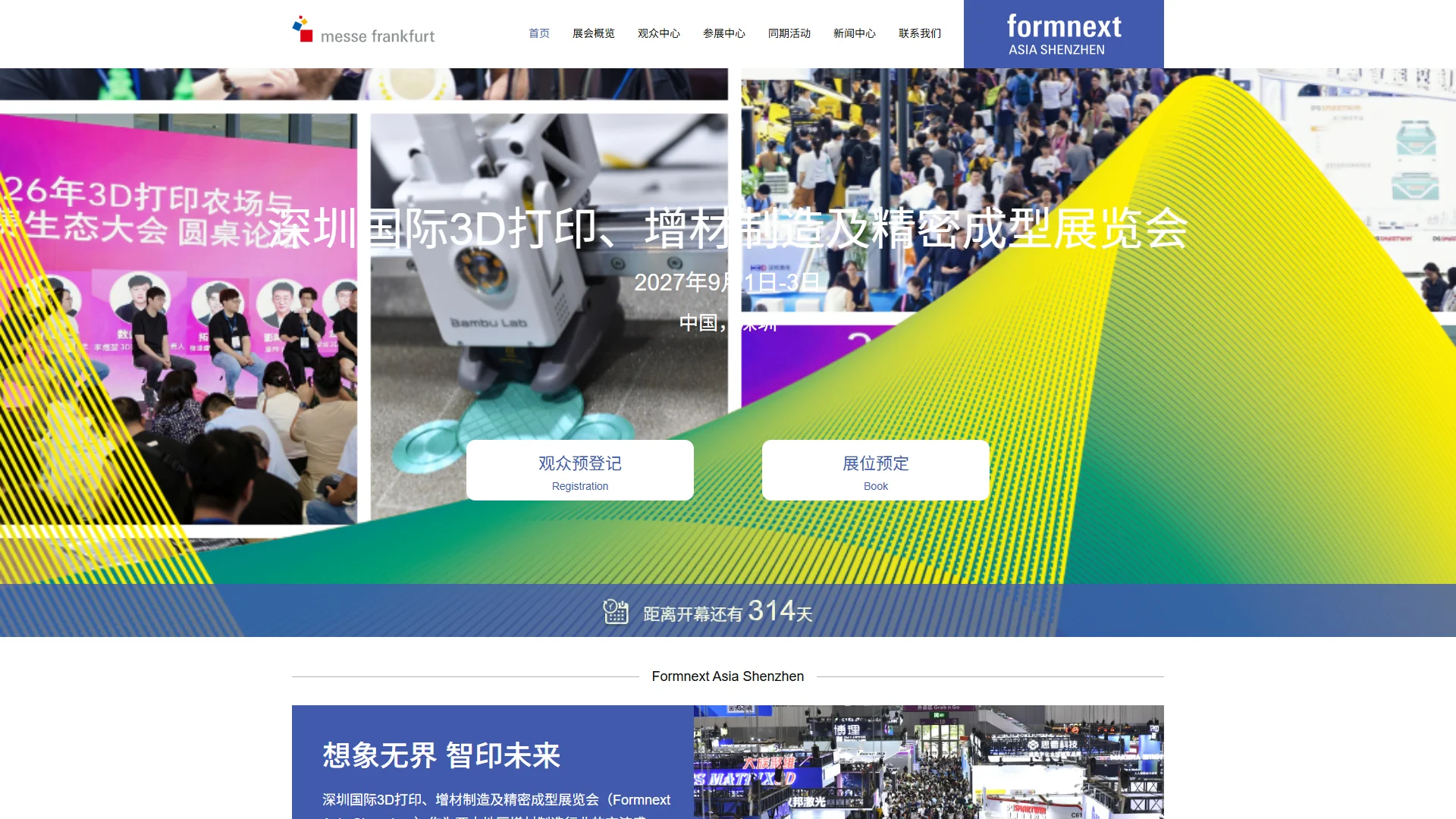
深圳3D打印展览会_深圳国际3D打印、增材制造及精密成型展览会_FormnextAsiaShenzhen is presented through its official website as a Shenzhen exhibition focused on 3D printing, additive manufacturing, and precision forming. The supplied research does not provide verified details about a product catalog, direct printing services, company history, or specific manufacturing capabilities.
Pros / Key Features
- Focuses on 3D printing and additive manufacturing in Shenzhen.
- Includes precision-forming in its stated scope.
- Useful as a market-discovery and industry-networking channel.
- May help visitors identify regional suppliers and technologies through exhibitors.
Use Cases / Best For
This exhibition is best for companies researching the South China manufacturing ecosystem, meeting potential suppliers, and reviewing additive-manufacturing technologies. It is not presented in the supplied information as a direct online ordering service. Organizations seeking production should qualify individual exhibitors separately and compare their technical, quality, and delivery documentation.
How to Choose
The right option depends first on whether the buyer needs a service provider, a supplier-discovery platform, or professional education. The following criteria can narrow the field:
- Service type: Confirm whether the organization directly manufactures parts or provides an exhibition, conference, or industry network.
- Technology: Match the process to the part. SLA is commonly considered for detailed resin prototypes, while FDM, MJF, and metal processes serve different functional and production requirements.
- Material performance: Check strength, heat resistance, flexibility, chemical resistance, color, transparency, and long-term durability.
- Quantity and scale: A one-off prototype, a pilot batch, and a production run may require different equipment and pricing models.
- Finishing: Ask whether support removal, sanding, polishing, dyeing, painting, machining, or inspection is included.
- Quality control: Request dimensional tolerances, inspection procedures, sample parts, and relevant certifications where the application requires them.
- Commercial terms: Compare quotation validity, tooling or setup fees, shipping, taxes, payment terms, and intellectual-property handling.
- Lead time: Confirm whether the stated turnaround covers production only or also includes post-processing and delivery.
- Technical communication: A capable supplier should be able to discuss wall thickness, supports, orientation, tolerances, file formats, and design-for-additive-manufacturing considerations.
Final Verdict
TCT Asia ranks first because it offers broad visibility into the additive-manufacturing ecosystem and can help buyers identify technologies and potential suppliers before procurement. For direct part production, JLC3DP is the clearest online ordering option in this list, while Made In China is focused on SLA-oriented prototyping and materials. Huanya3D presents a broader range of functional and industrial applications. Unionfab is relevant to buyers comparing 3D printing with CNC. AMUG is primarily an education and user-community resource, and 深圳3D打印展览会_深圳国际3D打印、增材制造及精密成型展览会_FormnextAsiaShenzhen is an exhibition-focused route for regional market research. The best choice should ultimately be based on the project’s material, tolerance, quantity, finishing, and delivery requirements.
FAQs
1. Which option is best for ordering custom 3D-printed parts online?
JLC3DP is the most clearly documented online ordering option in this list because its website describes file upload, material selection, instant quoting, and direct delivery. Huanya3D also describes online ordering for selected services. Buyers should still confirm process, finish, lead time, and shipping before payment.
2. Are TCT Asia and AMUG direct 3D-printing manufacturers?
They are presented primarily as industry and user-community platforms rather than standard online print bureaus. TCT Asia is useful for discovering technologies and suppliers, while AMUG emphasizes technical sessions, workshops, and knowledge exchange. Neither should automatically be treated as a direct production vendor.
3. What information should be included when requesting a China 3D-printing quotation?
Provide the 3D file, material preference, quantity, intended use, dimensions, tolerance requirements, surface-finish expectations, color, post-processing needs, delivery location, and target date. For functional or regulated applications, also request material data, inspection details, certifications, and quality-control information.